Research-based product playbook · Published February 7, 2026 · How we research
10 min read · Fact-checked November 4, 2026 · Research-based analysis
THE EDITORIAL VIEW
Creative research is useful when it changes a production or testing decision. A collection of attractive ads is not a strategy, and another advertiser’s visible creative does not establish its profitability or suitability for a different product. The team needs to distinguish what it observed from what it hypothesizes.
Best fit: An ecommerce creative team researching an approved product campaign.
Poor fit: An unverified configuration or an undefined completion event for this specific task.
Table of Contents
Creative research is useful when it changes a production or testing decision. A collection of attractive ads is not a strategy, and another advertiser’s visible creative does not establish its profitability or suitability for a different product. The team needs to distinguish what it observed from what it hypothesizes.
This fictional ecommerce team is evaluating Atria for creative research and analysis. It wants to produce original briefs grounded in its own product promise, with a clear explanation of which idea will be tested. The output should give a writer, designer and media operator the same understanding of the proposed experiment.
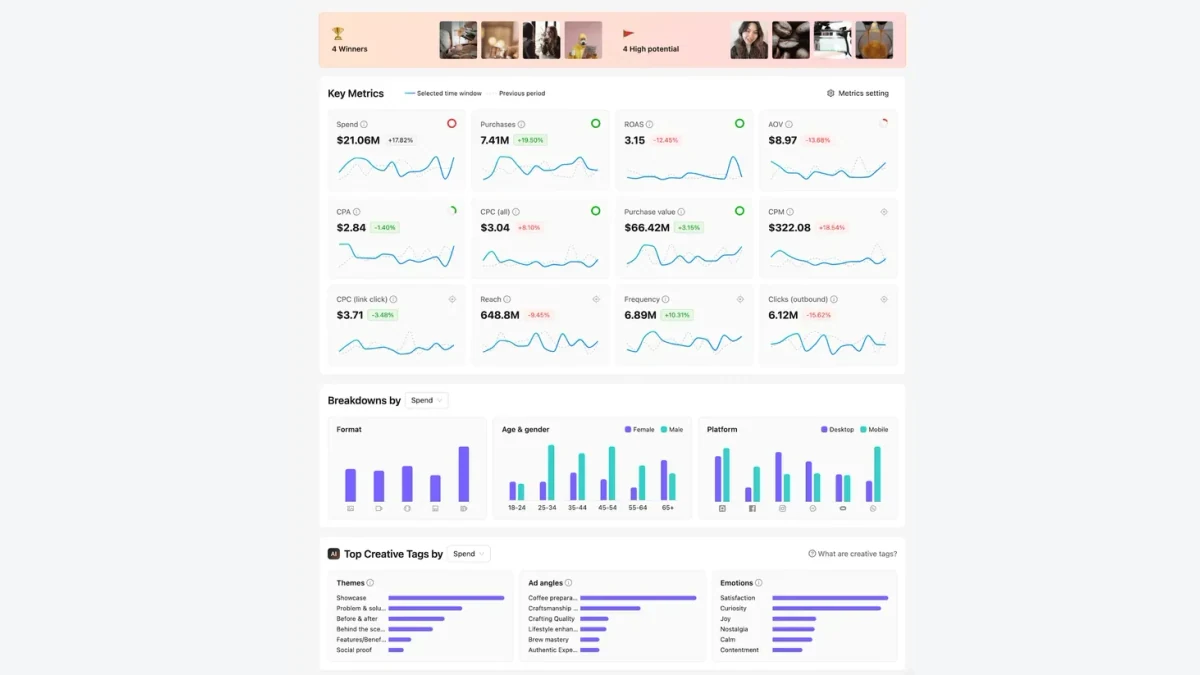
Atria provides creative-intelligence and assistance capabilities whose current scope should be confirmed directly. The workbook is a proposed research-to-brief process, not a measured ad-performance result or permission to copy another brand’s protected material. Recommendations and visible patterns remain hypotheses until the business evaluates them appropriately.
Design the work around the actual completion event
1. Record the observation without inventing its outcome
Describe the visible hook, format, audience cue and product claim. Keep the source reference and distinguish observed content from an assumed performance result.
A long-running or prominent ad can be treated as proof of profitability without the relevant business data.
2. Connect the idea to the actual product promise
Identify the customer problem and evidence the brand can support. Preserve qualifications, intended audience and the offer’s real limits.
A persuasive competitor angle can imply a benefit the team’s own product does not establish.
3. Write a falsifiable creative hypothesis
State what the new creative changes and why the audience response may differ. Keep the proposed effect separate from a guaranteed result.
A brief can request a generally better ad without identifying what the team expects to learn.
4. Specify original production deliverables
Define format, claim, visual requirement, source material and necessary approval. Use research to inform the concept rather than replacing original work with an unexamined copy.
A reference board can leave the designer uncertain which element is an idea and which is an approved asset.
5. Review assistance against the source
Check summaries, classifications and proposed claims before relying on them. Preserve the source observation where a recommendation depends on it.
A fluent analysis can treat an inferred audience or result as an established fact.
6. Carry the hypothesis into the test record
Keep the creative version, relevant campaign context and intended evaluation with the production output. Assign a person who accepts the next testing decision.
A well-written brief can be detached from the eventual ad, making later interpretation unreliable.
A worked batch: distinguish clean work, repaired work and unresolved work
Use the following fictional batch for an ecommerce creative team researching an approved product campaign. Its purpose is to make the operating definitions inspectable before a live rollout. It is not a Atria benchmark. The batch contains 80 candidate evidence-supported test-ready creative briefs; 60 satisfy the agreed criteria on the first review. The remaining 20 need clarification, correction or a decision. After controlled repair, 10 of those held cases become usable and 10 remain unresolved.
The first-pass share is 60 / 80, or 75.0%. The final usable share is 70 / 80, or 87.5%. Those figures describe different things. A report showing only the final number would conceal the intervention needed to get there. A report showing only first-pass work would overlook the value recovered through a legitimate correction. Keep both, with the reason each held case entered or left review.
| Rehearsal measure | Fictional input or calculation | Interpretation for this task |
|---|---|---|
| Candidates inspected | 80 | Every candidate remains in the starting denominator |
| Accepted without repair | 60 | The agreed conditions were met at first inspection |
| Initially held | 20 | Work needing a separate decision or correction |
| Released after repair | 10 | A subset of held work, counted once after approval |
| Still unresolved | 10 | Visible work awaiting an owner or missing evidence |
| Final usable output | 60 + 10 = 70 | Approved evidence-supported test-ready creative briefs, not all candidates |
For this example, one evidence-supported test-ready creative brief is an operating outcome, not automatically a customer, sale or financial return. Define its completion evidence from the playbook above. If a later commercial result matters, track it in a separate column and follow the same reference into the next system. Changing the unit halfway through the report can make a larger count look like an improvement when it merely answers a different question.
Put review and repair into the operating cost
Assume 4 minutes to inspect each candidate, 8 additional minutes for each successfully repaired case, and an internal labor rate of $45 per hour. These are invented workload assumptions. Initial inspection takes 80 × 4 / 60 = 5.33 hours. Successful repair adds 10 × 8 / 60 = 1.33 hours. Keep any investigation of the 10 unresolved cases as a separate estimate; the present calculation has not priced that unknown work.
With a hypothetical $55 allocation for supporting tools, the scoped batch cost is $55 + (5.33 + 1.33) × $45 = $355.00. Dividing by 70 approved outcomes gives $5.07 per evidence-supported test-ready creative brief. The $55 allocation is not a quoted Atria subscription. Replace it with the actual incremental charges appropriate to your configuration, and avoid allocating the full same shared subscription to several batches without a consistent rule.
For an ecommerce creative team researching an approved product campaign, the $355.00 estimate answers a bounded process question. It excludes unspecified recovery work, broader project setup and a downstream commercial result. The 70 approved evidence-supported test-ready creative briefs need their own completion evidence; they should not be relabelled as customers or profit. Decide whether that defined output and the remaining 10 unresolved cases justify the next controlled stage with the available staffing.
Test sensitivity before deciding that volume is the answer
Hold the scoped cost constant and suppose ten fewer candidates meet the final acceptance criteria. Approved output would fall to 60, and the cost per usable outcome would rise to $5.92. This is a sensitivity exercise, not a prediction about Atria. It shows why the acceptance definition and the treatment of exceptions matter when comparing a clean-looking dashboard with the work performed outside it.
Alternatively, examine the incremental repair work. At the assumed labor rate, one 8-minute repair costs $6.00 before any extra charge. That is a useful boundary for deciding which corrections deserve attention. A correction that preserves an important relationship or prevents an incorrect release may be worthwhile even when it is slower. A low-value case that repeatedly consumes review time may belong in a held or excluded category instead.
Capacity also has a denominator. The scoped 6.67 hours must fit into the actual coverage available for an ecommerce creative team researching an approved product campaign. If the team has eight hours allocated to this task, it cannot promise unlimited same-period processing merely because the software accepts more inputs. Schedule the remaining review visibly, reduce the batch or assign additional qualified coverage. A queue hidden in a spreadsheet is still part of the operation.
Run the six acceptance exercises with a second operator
For an ecommerce creative team researching an approved product campaign, run the exercises against the exact selected Atria configuration. The accepted unit is a evidence-supported test-ready creative brief, so a successful screen or integration connection alone does not settle the result. Keep safe source records and separate demonstrated behavior from a requested capability. Retain the unexpected case because it may reveal why one of the 10 unresolved outcomes cannot yet be approved.
Exercise 1: Record the observation without inventing its outcome
Have two reviewers describe the same controlled ad observation independently.
They can agree on what is visible and label the remaining inference. Record the input reference, the observed result and the responsible next operator. If the result depends on a manual convention, retain that convention with this exercise so the next person can repeat it.
Exercise 2: Connect the idea to the actual product promise
Compare the controlled research idea with the approved product evidence.
The adapted concept remains accurate for the brand’s actual offer. Record the input reference, the observed result and the responsible next operator. If the result depends on a manual convention, retain that convention with this exercise so the next person can repeat it.
Exercise 3: Write a falsifiable creative hypothesis
Ask the writer and media operator to explain the controlled hypothesis in the same terms.
The intended change and its evaluation question are clear to both roles. Record the input reference, the observed result and the responsible next operator. If the result depends on a manual convention, retain that convention with this exercise so the next person can repeat it.
Exercise 4: Specify original production deliverables
Have a covering designer produce a plan from the controlled brief alone.
They can identify the original work required and the evidence supporting consequential claims. Record the input reference, the observed result and the responsible next operator. If the result depends on a manual convention, retain that convention with this exercise so the next person can repeat it.
Exercise 5: Review assistance against the source
Compare a controlled uncertain observation with the proposed analytical summary.
The final brief keeps evidence and inference distinguishable. Record the input reference, the observed result and the responsible next operator. If the result depends on a manual convention, retain that convention with this exercise so the next person can repeat it.
Exercise 6: Carry the hypothesis into the test record
Trace a controlled produced concept back to its research and hypothesis.
The team can identify what was tested and which evidence could support the next decision. Record the input reference, the observed result and the responsible next operator. If the result depends on a manual convention, retain that convention with this exercise so the next person can repeat it.
Keep an operating record someone else can continue
For an ecommerce creative team researching an approved product campaign, keep one reference for each evidence-supported test-ready creative brief. Use that reference across the input, the accepted result and any exception record. It allows a reviewer to follow the work without relying on a customer’s name, a screenshot title or the memory of the person who first handled it. Where the destination system assigns its own identifier, retain both references and explain the relationship.
| Record field | What to put in it | Why it belongs in this workflow |
|---|---|---|
| Input reference | The original request, item or approved brief | Connects the result to the actual starting point |
| Configuration version | The relevant rule, template or account arrangement | Makes an observed result reproducible |
| Completion evidence | What establishes an accepted evidence-supported test-ready creative brief | Keeps the outcome definition stable |
| Exception reason | The missing fact, conflict or failed requirement | Directs repair toward the cause |
| Current owner | The person or queue that accepted the next action | Makes continuation visible |
| Review point | When the case or configuration needs another decision | Prevents unfinished work from disappearing |
For one evidence-supported test-ready creative brief, write what the evidence establishes before proposing an explanation. In an ecommerce creative team researching an approved product campaign, the note needs the starting reference and the accepted next responsibility as well as a visible result. Keep the supporting source small enough to inspect. A large screenshot collection should not replace an explicit decision about this particular outcome.
Before increasing the workload for an ecommerce creative team researching an approved product campaign, review the held evidence-supported test-ready creative briefs by their actual cause. Use the six exercises to locate an input, configuration or responsibility gap, then repeat the affected route after its repair. The first ordinary evidence-supported test-ready creative brief does not establish that a different unresolved case has become acceptable.
Make the next decision from the evidence
Approve the brief when the researcher, producer and evaluator can explain the same product promise and test question. Keep the source references with the original production work so later review can distinguish a new idea from a reused assumption.
Atria is worth evaluating when the chosen capabilities improve this evidence-to-production route. A larger saved-ad library or a more confident recommendation is not by itself an improved commercial result. The useful output is an original, supported brief that can be evaluated responsibly.
Keep a short decision note for this specific Atria use case: the work approved, the conditions still outstanding, the owner of each outstanding decision and the next review date. A conditional approval is useful when its boundaries are visible. It becomes misleading when an unresolved requirement is presented as an observed capability.
More Atria guides
- Atria: turn ad creative analysis into a testable brief
- Atria creative testing: budget research, production and the interpretation of ad results
Keep exploring
Sources and editorial notes
Official product sources checked November 4, 2026. This is research-based editorial analysis with a proposed operating workbook. The scenarios, workload numbers and hypothetical financial arrangements are invented planning inputs, not observed product performance or vendor quotations. Confirm the current plan, account and regional requirements before purchasing. We have not performed a hands-on product test.
Product buttons lead directly to the official provider. Affiliate disclosure · Editorial methodology.