Research-based product playbook · Published March 27, 2026 · How we research
10 min read · Fact-checked November 4, 2026 · Research-based analysis
THE EDITORIAL VIEW
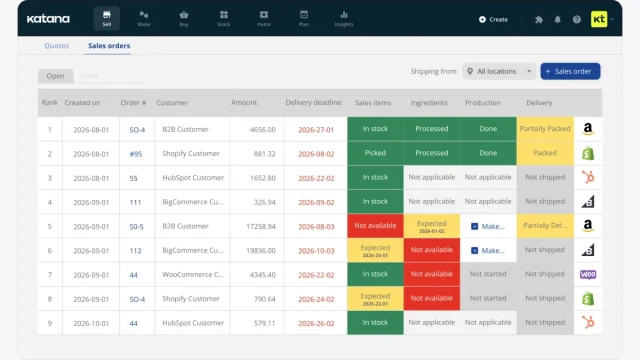
An order can arrive through the same channel but require a different fulfillment route. Warehouse work, channel fulfillment, holds and changed orders need to remain distinguishable in the record and in the cost model. A total order count alone cannot describe that operating mix.
Best fit: A multichannel brand coordinating warehouse-fulfilled and channel-fulfilled orders.
Poor fit: An unverified configuration or an undefined completion event for this specific task.
Table of Contents
An order can arrive through the same channel but require a different fulfillment route. Warehouse work, channel fulfillment, holds and changed orders need to remain distinguishable in the record and in the cost model. A total order count alone cannot describe that operating mix.
This fictional brand is evaluating Goflow for a combination of its own warehouse and channel fulfillment. It wants to preserve the original order promise, choose an appropriate route and reconcile the outcome. The team also needs to understand which volume definitions determine the purchased arrangement.
The Goflow pricing material reviewed for the main guide distinguished order categories and their treatment, including channel-fulfilled orders and wholesale-related scope. Confirm the current definition for the actual connected setup. The hypothetical arrangements below illustrate complete-cost reasoning; they are not Goflow prices or a claim that every order uses the same fee unit.
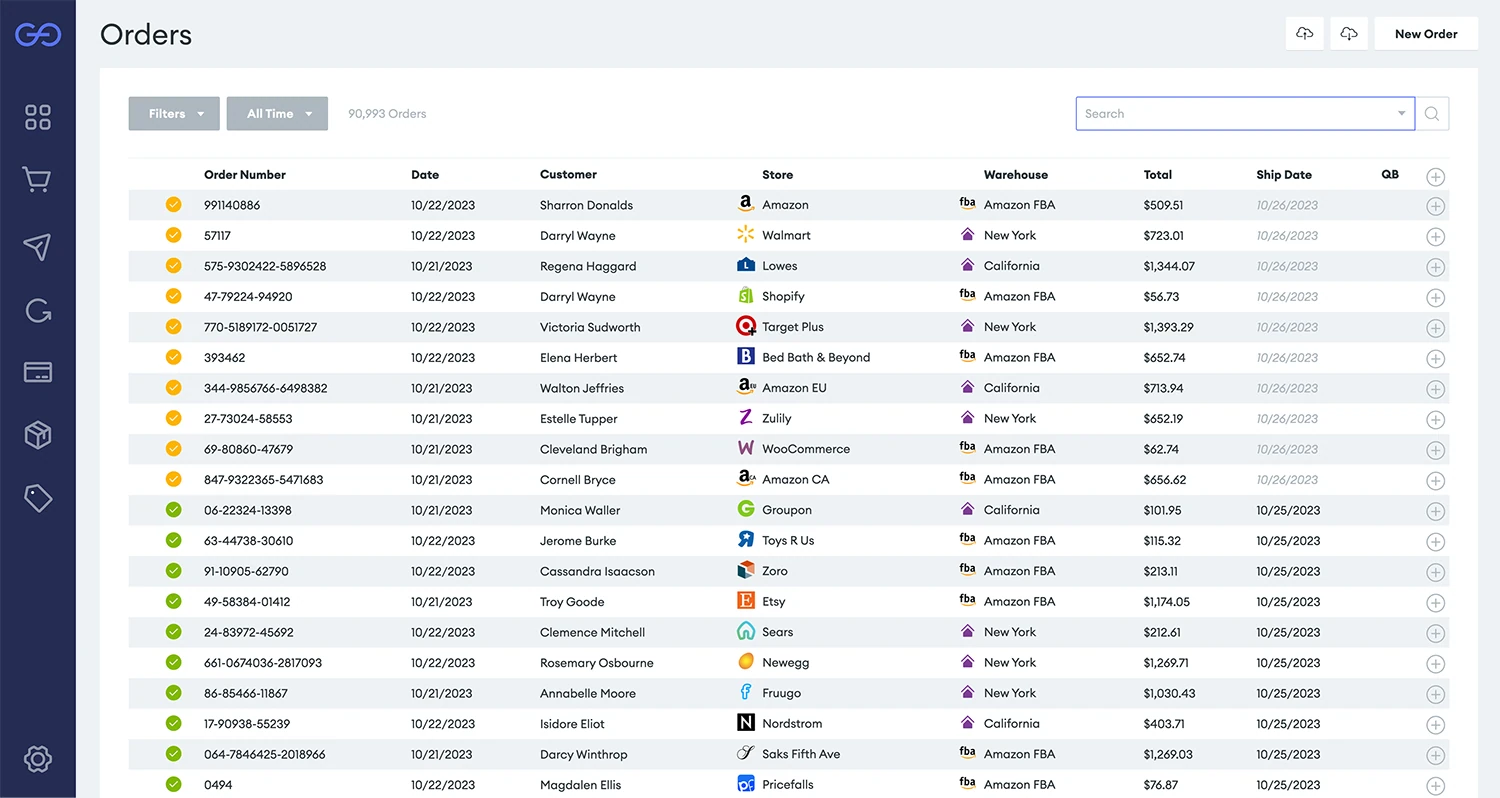
Design the work around the actual completion event
1. Classify the fulfillment obligation
Identify the order’s source, current owner and intended fulfillment arrangement. Keep a customer order separate from the internal decision about who will dispatch it.
An imported order can be sent to the warehouse even when another route already owns fulfillment.
2. Preserve the promise through routing
Record the relevant items, quantity, delivery requirement and approved customer change. Confirm what the actual configuration uses to make the routing decision.
A convenient stock location can be chosen without satisfying the delivery promise that created the order.
3. Handle cancellation and changes deliberately
Identify the authoritative order state and the point after which a change requires another decision. Preserve the source event and the effect on the chosen fulfillment route.
A changed channel order can coexist with active warehouse work based on an earlier state.
4. Reconcile the provider volume definitions
Map the actual order mix to the current purchased definitions. Keep distinct order categories separate instead of multiplying one nominal rate across the entire operation.
A simple average can hide a billing boundary or a route with different operating work.
5. Include the cost of routing exceptions
Measure review time for missing mappings, unavailable stock and conflicting order states. Separate one-time channel setup from recurring case work.
A software amount can appear economical while a repeated routing failure consumes the warehouse supervisor’s time.
6. Close the period with owned differences
Reconcile original orders, accepted routes, dispatched or channel-completed cases and unresolved work. Group differences by cause and next owner.
A completed import count can conceal orders still awaiting a real fulfillment decision.
Build a complete cost model with a consistent unit
The following comparison is a fictional purchasing exercise for a multichannel brand coordinating warehouse-fulfilled and channel-fulfilled orders. Arrangement A and arrangement B are hypothetical configurations, not named Goflow plans or current vendor prices. Their purpose is to expose a fixed-cost versus workload tradeoff. Replace every amount with the provider quote and the team’s observed work before making a purchasing decision.
Assume 400 attempted reconciled owned fulfillment decisions in one review period. Arrangement A has $160 of allocated fixed cost and $1.20 of variable cost per attempt. Arrangement B has $340 of fixed cost and $0.60 per attempt. Both also require an assumed 7 hours of operating work at $40 per hour. That shared labor amount is $280. Keeping it visible prevents a subscription comparison from being mistaken for the complete cost of running the process.
| Cost component | Arrangement A | Arrangement B |
|---|---|---|
| Allocated fixed amount | $160 | $340 |
| Attempted workload | 400 | 400 |
| Variable amount per attempt | $1.20 | $0.60 |
| Variable subtotal | $480.00 | $240.00 |
| Assumed operating labor | $280 | $280 |
| Scoped total | $920.00 | $860.00 |
Under these inputs, the lower scoped total is B. The arithmetic does not establish functional equivalence. If one arrangement cannot produce an accepted reconciled owned fulfillment decision, its lower price does not purchase the same outcome. First establish that the relevant permissions, product functions and receiving workflow satisfy the requirement. Then compare the cost of the arrangements that remain eligible.
Calculate the crossover instead of choosing from one sample month
Ignoring the shared labor that is identical in this example, set the two totals equal: 160 + 1.20 × volume = 340 + 0.60 × volume. The difference in fixed amounts is $180; the variable difference is $0.60 per attempt. The crossover is therefore 300 attempts. Below that level A has the lower modeled platform allocation; above it B does, assuming the same definitions and the same quality of output.
For Goflow, inspect the actual connected order categories and their current volume definitions. Warehouse-fulfilled, channel-fulfilled and relevant wholesale work should not be merged into one assumed billing unit. Preserve mapping and routing review when comparing the quoted arrangement. The 400 attempted reconciled owned fulfillment decisions in this example are an internal operating measure. Translate them into the confirmed purchased units before replacing the hypothetical costs. A minimum commitment, annual term or tier boundary may require a different model; retain the current quote with its actual scope.
Divide by accepted output as well as attempted work
Suppose 320 of the 400 attempts meet the agreed completion criteria. This invented usable-output share is 80%; it is not a Goflow success rate. Arrangement A would cost $2.88 per approved reconciled owned fulfillment decision, while B would cost $2.69. Dividing by all attempts instead would give $2.30 and $2.15. Both calculations are arithmetically valid, but only the first answers the question about accepted operating output.
Explain what happened to the remaining 80 cases. Some may be inappropriate inputs; others may need a correction or an unavailable decision. Do not describe them all as software failures. Equally, do not erase their inspection cost from the comparison. A useful review separates input quality, the configuration’s behavior and the receiving team’s ability to continue the work. Each requires a different response.
Include switching effort and the cost of carrying an exception
A new arrangement may require preparation, record cleanup, template work or training. If a controlled estimate adds twelve hours at the same $40 rate, that is $480 of transition labor. State whether it is a one-time investment and over what period you intend to recover it. Do not treat it as a monthly fee indefinitely or disappear it from the decision merely because an existing employee performs the work.
Now vary the exception burden. Adding four hours of review increases either arrangement by $160. That can be more consequential than a small difference in the quoted fee. The practical question is which input or handoff creates those hours and whether the proposed configuration removes them. A larger allowance that leaves the repair process untouched may increase throughput without making the work more economical.
For a multichannel brand coordinating warehouse-fulfilled and channel-fulfilled orders, compare quiet, expected and spike periods using the same reconciled owned fulfillment decision definition. The modeled 400 attempts are only one workload. A changed package boundary or approval burden can alter the comparison, so retain a range where the work is uncertain. Link the commitment to the actual requirement and review point rather than treating the spreadsheet’s decimal places as evidence that future demand is known.
Test the six assumptions that could change this budget
The following exercises connect the financial model to the actual Goflow workflow. Keep input definitions, the selected configuration and the person responsible for each decision beside the observed result. A provider demonstration can establish an available route; it does not replace the team’s own acceptance of the business meaning or the ongoing work required to maintain it.
Exercise 1: Classify the fulfillment obligation
Compare controlled warehouse-fulfilled, channel-fulfilled and held orders.
Each has an explainable route and responsibility before release. Record the input reference, the observed result and the responsible next operator. If the result depends on a manual convention, retain that convention with this exercise so the next person can repeat it.
Exercise 2: Preserve the promise through routing
Route a controlled order with a particular delivery requirement and an unavailable preferred location.
The decision respects the approved customer commitment or reaches an owned exception. Record the input reference, the observed result and the responsible next operator. If the result depends on a manual convention, retain that convention with this exercise so the next person can repeat it.
Exercise 3: Handle cancellation and changes deliberately
Cancel or change a controlled order after its initial routing step.
The next action reflects the current approved state and any physical work already performed. Record the input reference, the observed result and the responsible next operator. If the result depends on a manual convention, retain that convention with this exercise so the next person can repeat it.
Exercise 4: Reconcile the provider volume definitions
Reconcile a controlled period containing the actual planned mix of fulfillment categories.
The quote and internal count can be explained from the same source records. Record the input reference, the observed result and the responsible next operator. If the result depends on a manual convention, retain that convention with this exercise so the next person can repeat it.
Exercise 5: Include the cost of routing exceptions
Cost a controlled clean order and one requiring a location or ownership decision.
The complete estimate reaches a reconciled fulfillment decision rather than import alone. Record the input reference, the observed result and the responsible next operator. If the result depends on a manual convention, retain that convention with this exercise so the next person can repeat it.
Exercise 6: Close the period with owned differences
Have a covering operator explain a controlled unmatched order from the review record.
They can find the source obligation and identify the next authorized action. Record the input reference, the observed result and the responsible next operator. If the result depends on a manual convention, retain that convention with this exercise so the next person can repeat it.
Keep an operating record someone else can continue
For a multichannel brand coordinating warehouse-fulfilled and channel-fulfilled orders, keep one reference for each reconciled owned fulfillment decision. Use that reference across the input, the accepted result and any exception record. It allows a reviewer to follow the work without relying on a customer’s name, a screenshot title or the memory of the person who first handled it. Where the destination system assigns its own identifier, retain both references and explain the relationship.
| Record field | What to put in it | Why it belongs in this workflow |
|---|---|---|
| Input reference | The original request, item or approved brief | Connects the result to the actual starting point |
| Configuration version | The relevant rule, template or account arrangement | Makes an observed result reproducible |
| Completion evidence | What establishes an accepted reconciled owned fulfillment decision | Keeps the outcome definition stable |
| Exception reason | The missing fact, conflict or failed requirement | Directs repair toward the cause |
| Current owner | The person or queue that accepted the next action | Makes continuation visible |
| Review point | When the case or configuration needs another decision | Prevents unfinished work from disappearing |
For one reconciled owned fulfillment decision, write what the evidence establishes before proposing an explanation. In a multichannel brand coordinating warehouse-fulfilled and channel-fulfilled orders, the note needs the starting reference and the accepted next responsibility as well as a visible result. Keep the supporting source small enough to inspect. A large screenshot collection should not replace an explicit decision about this particular outcome.
Before increasing the workload for a multichannel brand coordinating warehouse-fulfilled and channel-fulfilled orders, review the held reconciled owned fulfillment decisions by their actual cause. Use the six exercises to locate an input, configuration or responsibility gap, then repeat the affected route after its repair. The first ordinary reconciled owned fulfillment decision does not establish that a different unresolved case has become acceptable.
Make the next decision from the evidence
Choose a Goflow arrangement around the actual order mix, channel scope and routing requirements. Preserve the current provider definitions with the model and recheck them when a new channel or fulfillment route is introduced.
The useful output is an owned, reconciled fulfillment decision that leads to the intended customer result. A larger nominal order allowance is valuable only when the item mapping, routing and exception process remain understandable at that volume.
Keep a short decision note for this specific Goflow use case: the work approved, the conditions still outstanding, the owner of each outstanding decision and the next review date. A conditional approval is useful when its boundaries are visible. It becomes misleading when an unresolved requirement is presented as an observed capability.
More Goflow guides
- Goflow: make multichannel orders follow one operating model
- Goflow channel mapping: connect listings to the inventory item the warehouse uses
Keep exploring
Sources and editorial notes
Official product sources checked November 4, 2026. This is research-based editorial analysis with a proposed operating workbook. The scenarios, workload numbers and hypothetical financial arrangements are invented planning inputs, not observed product performance or vendor quotations. Confirm the current plan, account and regional requirements before purchasing. We have not performed a hands-on product test.
Product buttons lead directly to the official provider. Affiliate disclosure · Editorial methodology.